


The Tashkent Aircraft Factory will work for the Peoples Liberation Army of China
Comments (1)
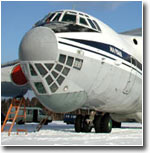
The recent visit of a Duma delegation to Uzbekistan once again drew experts' attention to the Tashkent Aircraft Factory named after Chkalov. The delegation included Andrei Kokoshin, Chairman of the Committee for CIS Affairs and Compatriots, who it seems played the part of lobbyist of the Russian military-industrial complex. When a deputy defense minister of Russia once, Kokoshin actively promoted the idea of powerful holdings in the national defense industry.
According to Kokoshin, President of Uzbekistan Islam Karimov suggested a new pattern of Chkalov Factory privatization and invited Russian capitals to participate. No details are available at this point.
Authorized fund of the Chkalov Factory is split among the Uzbek state (51%), employees (10%), National Bank of Foreign Economic Activities (6.7%), Agency of Foreign Economic Contacts (6.7%), and some minor owners. On several occasions already Russia asked Tashkent to sell the controlling interest to Ilyushin Company in order to form a Russian-Uzbek aircraft holding. Tashkent did not object to the idea of the holding as such but always insisted on the direct sale of the stock. The last international auction for 25.6% of the stock in the Chkalov Company worth $120.8 million was to take place last spring. It never happened because nobody turned up to apply for the stock of the only aircraft manufacturer in Central Asia.
And yet, the factory remains a fairly promising asset. Experts say that the market capacity for IL-76s assembled in Tashkent amounts to 90-100 planes for until 2015 including up to 70 planes needed by foreign countries like China, India, South Korea, Iran, Jordan, Azerbaijan. One such plane may cost $25-35 million.
Airbus Corp. specialists predict in the meantime that the volume of air freight transport (ton per kilometer) will keep growing by 5.9% a year until 2025, requiring delivery of over 700 brand-new transport planes and conversion of 2,400 passenger ones into transports. An emphasis will be made on the transport planes with considerable carrying capacity.
IL-76s may occupy their niche in the market provided they are outfitted with the engines that meet the requirements of the International Organization of Civil Aviation. On January 12, 2006, the International Aviation Committee certified Ilyushin Company's IL-76TD-90VDs as meeting the requirements, making them the first Russian planes welcome on international air routes without restrictions.
Manufacture of IL-76s for foreign customers is particularly interesting. Last autumn, Beijing grew interested in acquisition of 32 IL-76MDs and 6 flying tankers IL-78MK for the People's Liberation Army of China. Deployed in the Russian-Chinese Peace Mission'2005, the planes drew the attention of the Chinese. Summing up the outcome of the exercise, defense minister of China said, "We intend to make the Chinese Airborne Troops like the Russian ones within a decade!"
Fourteen planes of this type have been sold to China so far. As a matter of fact, Beijing is even prepared to buy planes with old D30-KP-2 engines. This is a clear indication of China's determination to put the planes to military use only.
China is out to buy enough aircraft for a military transport regiment which may signify the intention to rearm Military Transport Aviation of the People's Liberation Army. China is currently in the second phase of a long-term program of development of its Armed Forces that are supposed to become a force "guaranteeing expansion of strategic borders and room" by 2010. Phase Three of the program (2010 - 2050) is supposed to end in establishment of the Armed Forces capable "of winning a war on any scale and of any intensiveness with the use of all modern ways and means of warfare."
Since absorption of Taiwan is China's principal geopolitical task at this point, the plans of the future hostilities cannot help including the element of airlift at the initial stage.
The Airborne Troops of the People's Liberation Army include three divisions. In the meantime, China lacks modern military transport units to airlift and land them. IL-76MDs (or IL-76MF, their modification with a longer fuselage) assembled in Tashkent are ideal for the purpose. There is only one analog in the world - the American C-17 Globemaster, but it is much more expensive and the Americans part with any with a clear reluctance.
It seems that we should expect in the near future some progress in establishment of a Russian-Uzbek venture on the base of the Chkalov Factory. Experts do not rule out the possibility that what Boris Aleshin suggested in October 2005 will be realized. The head of the Russian Federal Agency for Industry, he suggested an exchange of the Chkalov Factory stock for that of the United Aircraft Corporation established in Russia.
Successful auctioning of the Chkalov Factory will make the Russian-Uzbek tandem a factor to be reckoned with in the international market of transport plane production.
* * *
From Ferghana.Ru folders: The Tashkent Aircraft Factory was established on the base of Aircraft Factory No 84 evacuated from Khimki near Moscow to Uzbekistan in 1941. It took the facility only two months since arrival at a thoroughly unprepared site in Tashkent to assemble the first aircraft. It happened on January 7, 1942. Serial production of aircraft for WWII began on January 17, 1942.
From Ferghana.Ru folders: The Tashkent Aircraft Factory is one of the largest enterprises in the Commonwealth and Asia in its field. It specializes in manufacture of wide-body transport IL-76 and its numerous modifications (TD, MD, MF, TF, IL-78, and so on), passenger plane IL-114 and its transport model IL-114T.
* * *
President of Russia signed a decree on establishment of the United Aircraft Corporation, the Kremlin's press service reported on February 21, 2006. Belonging to the state by 75%, the corporation will include all major aircraft manufacturers. Authors of the idea expect the United Aircraft Corporation to revive the Soviet aircraft industry and promote domestically-made planes in the international market. Turnover of the corporation is expected to reach $8.5 billion by 2015.
The United Aircraft Corporation is supposed to become a conglomerate of Sukhoi, MIG, Ilyushin, Irkut, Yakovlev Design Bureau, and Tupolev.
Their unification is to take between nine months and a year. The head of the corporation will be appointed before the end of 2006.
Structure of the corporation will resemble those of Boeing and EADS. It was pointed out at Cabinet meetings that the annual output would amount to 120 civil planes by 2013. These days, output of the Russian aircraft industry amounts to only 9 planes a year.
Igor Zenkov, an expert with the Central Asian Information Center