


Display of the Museum of Victims of Repressions in Tashkent causes some bitter associations
Comments (0)
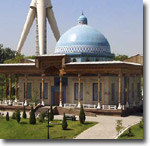
Shahidlar Hotirasi is the complex located on the bank of the Bozsu near the TV tower. It was built practically in the center of the capital of Uzbekistan on President Islam Karimov's order in 2002. Uzbek historians maintain that the complex is located precisely at the site where "enemies of the people" were executed en masse in the 1930's. A park was established there afterwards. The building of the memorial resembles ancient mausoleums.
History of political repressions is what the museum is about. Organizers of the museum claim that repressions on the territory of modern Uzbekistan began when the Turkestan province of the Russian Empire was established and ended in the 1990's, when Uzbekistan retained sovereignty.
The beginning of the exposition lacks any explanatory notes in Russian probably because it is dedicated to the period of Russian conquest of Central Asia. Only a brief resume is translated into the Russian language, a minor masterpiece of literature in the genre of the so called alternative history.
Here it is. "Predatory policy of the Tsarist army in the 1860's and 1870's with regard to the Kokand, Hiva, and Buhara emirates encountered ferocious resistance of our forefathers. The aggressors' military superiority enabled them to crush the resistance. The Turkestan province was formed and colonial regime established on the conquered lands. Pursuing its aggressive policy, the Russian Empire inevitably destroyed statehood of the conquered countries and transformed the latter into its colonies. Trampling on the conquered peoples' religious beliefs and national culture and violating their rights, the Tsarist Russia robbed the territories of everything. The best fertile lands were turned over to Russian settlers."
A thorough account of the anti-Russian revolt in Jizak in 1916-1917 is given in the Uzbek language. The uprising was fomented by the attempt to mobilize the local population for rear services in the Russian army fighting World War I. The mobilization was called during the sacred month of Ramadan. Excited by this sacrilege and the rumors that the Russian army was using the Asians as a live shield on the German front, the locals began protesting against the colonial administration and soon enough turned their wrath on the Russians in general.
It should be added that the museum was established in the period when Uzbekistan was a strategic ally of NATO and America, before the signing of a new alliance with the Russian Federation. Between the early 1990's and the recent turn to Russia, Uzbek history text-books were viciously critical of the "Russian colonizers". Literally millions of Uzbek kids visited the museum in its first several years of existence, given free tours of the exposition that visitors inevitably associate with Orwell's "5 minutes of hatred".
"Established by the Bolsheviks, the VChK [or All-Russian Emergency Commission, predecessor of the NKVD and KGB] pressed charges against 450,000 innocents in Uzbekistan between December 1917 and 1939. It was a period when very many people were sentenced to short imprisonment only and released afterwards for the lack of corpus delicti. In 1937 and 1938, however, the state launched a major campaign against enemies of the people, and very many of these people were taken in, tried, and imprisoned again," the note explained. It is these comments that cannot help causing certain associations...
International human rights organizations maintain that thousands and thousands of people were imprisoned in Uzbekistan for religious and political motives in the last decade. Many of them recanted and sent pleas to President Karimov himself. This feigned remorse bought them freedom before their institutional time was over. Afterwards, however, all these people were taken in and imprisoned again.
Several show trials took place in sovereign Uzbekistan between 1999 and 2005. Local and foreign journalists were given leave to attend these trials where defendants had been charged with attempts to overthrow the regime. Defendants inevitably confessed every mortal sin and crime against the people and Karimov himself. When participants in the events in Andijan were being tried (the government troops mowed down hundreds of noncombatants in Andijan in May 2005), the defendants pleaded guilty and asked to be sentenced to death "twice".
"The Soviet regime went on neglecting and abusing national interests of Uzbekistan. $36 billion worth of cotton and gold were shipped from Uzbekistan to the center in the last fifteen years of existence of the USSR. Sum total of natural resources taken to Moscow in this period exceeded $75 billion. In the 1980's, Compulsory introduction of cotton as the only plant to be cultivated proved to the undoing of the Uzbek people. Cotton fields expanded more and more under the pressure from the center. In the late 1980's, the totalitarian regime transformed Uzbekistan into a zone of its predatory policy through fabrication of the shameful "Cotton Affair" also known as the "Uzbek Affair". Using the methods once preferred by Stalin and Beriya, Gdlyan and Ivanov ruined hundreds of innocents. Charges were pressed against 25,000 honest workers. Of them, 4,500 found themselves facing criminal charges and 3,600 stood trial. It was the will and determination of President Islam Karimov that exposed these political games and machinations on the part of the totalitarian regime and that ended in rehabilitation of the innocents."
In the meantime, political opponents of the regime, journalists, opposition leaders and activists, and human rights activists still find themselves prosecuted in Uzbekistan.
Sunny Coalition leader Sanjar Umarov, businessman and politician, was sentenced to 11 years imprisonment this spring. He had criticized the government of Uzbekistan and offered his own program of economic and social crisis resolution.
Public criticism of the regime for callous suppression of the revolt in Andijan earned Mutabar Tajibayeva, a human rights activist from Ferghana, eight years behind the bars. Locked up in a ward for mental patients in the colony, Tajibayeva called a hunger strike. She was eventually transferred to a prison in Tashkent.
Saidhajon Zainobitdinov, the first human rights activist to inform foreign journalists of how hundreds of noncombatants had been riddled with bullets in Andijan on May 13, 2005, was sentenced to seven years imprisonment for "slander and sowing of panic" in a closed trial.
The state would not abandon its policy of rewriting the history in the interests of its political and ideological leadership. Relatives and supporters of the imprisoned opponents of Karimov and his regime are convinced that Shahidlar Hotirasi exposition needs another part - a part describing their own tragedies.
Let us hope that new memorials will be built in Uzbekistan in the years to come. Say, dedicated to the repressions in Andijan and Jaslyk...