


Israeli Embassy in Uzbekistan absolves its security of murder
Comments (0)
That the passer-by had been shot by a mistake became clear right away when search of the body produced neither weapons nor high explosives. Security must have lost their nerve because exactly a year ago a terrorist had tried to blow up the Israeli Embassy. He only succeeded in killing two guards and himself. This time, everyone was understandably upset by the news pouring in from Andijan since the early morning: jail raided, city administration seized, regional office of the National Security Service under attack... Bracing for the worst, the guards shot someone in a trench coat approaching the Embassy and disobeying the order to "freeze" and "hold it".
News agencies' reports that a presumed terrorist had been shot near the Israeli Embassy in Tashkent gave way to reports on how security had shot "a so far unidentified person". Soon after that, even this status was denied the victim who ceased being "an unidentified person" and became a "tramp". Interest in the incident ebbed and eventually evaporated.
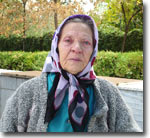
Only one person wouldn't let go. She is Zhanna Andreyevna Ignatenko, the mother of Georgy Alexandrov, the victim of the Israeli Embassy security. At nearly 80, Ignatenko looks much younger. She is of clear mind. Born in Tashkent, she had spent all her life there. Ignatenko was an economist prior to retirement. She cannot speak of her son without tears.
Georgy was the only child. His wife and child had lost in a traffic accident, he never remarried. Graduate from the Road Transport Institute, Georgy had been a traffic security engineer once. He eventually abandoned civil service and became a car mechanic. Georgy did not have an apartment of his own but that didn't make him a vag. Several years ago, Georgy and his mother had been swindled in the sale of their house. Ignatenko lived on the dacha in Brichmulla and Georgy in a rented apartment in Tashkent.
That morning, Georgy was walking down the street with the Israeli Embassy on it on his way to the notary's office. Several years of saving had enabled him to collect enough money for a small apartment, and that necessitated a visit to the notary's office. In fact, he had been there with his mother several days earlier. So, Georgy left the rented apartment on May 13 in the morning and never came back. Ignatenko was told that he had been shot three days later.
The Israeli Embassy took the shocking news of the murder of an innocent in stride. It declined comment and never even deigned to apologize or offer condolences. Ignatenko tried to meet with and talk to somebody on the Embassy staff. She never made it past the external defense perimeter, however, and whoever answered her calls to the Embassy inevitably replied that it was not something to be discussed on the phone. Ignatenko was merely told to approach the prosecutor's office with her problem.
The Tashkent Municipal Prosecutor's Office instituted criminal proceedings. Investigator Ulugbek Suleimanov promised to keep in touch and turned over what had been found on her son's body - keys, blood-smeared packs of banknotes (approximately 30,000 sums), and papers. According to Ignatenko, he said it had been Israeli guards who murdered her son.
All materials were eventually forwarded to the Yakkasarai District Prosecutor's Office on whose territory the Israeli Embassy is located. Ignatenko told the new investigator everything she knew. The Yakkasarai District Prosecutor's Office informed her in the middle of July that the matter was closed due to the impossibility "to identify the suspect".
"They are saying they cannot establish who did it," Ignatenko said. "It was early morning, the street was crowded, and they are saying there is no way to establish the murderer..."
Ignatenko approached the Tashkent Municipal Directorate of Internal Affairs. It never responded. She appealed to the Justice Ministry. The Justice Ministry answered that the matter had been turned over to the prosecutor general. Everything was soon back to square one, with the case in the hands of the Yakkasarai District Prosecutor's Office of Tashkent. Which, of course, answered the way it had done before. Translated from the officialese, this was what Prosecutor A. Hakimov's answer to her repeated pleas boiled down to (impossibility to identify the shooter).
Ignatenko wrote a letter and brought it to the presidential apparat herself. The paper was signed for, the complainant told to expect an answer within a month. The answer never came. Two months later, human rights activist Yelena Urlayeva helped Ignatenko to compose and mail another letter to the presidential apparat. The answer never came. Investigation of the death of a citizen of Uzbekistan was apparently over.
What hurts in this whole episode is indifference. Everything is clear with Uzbekistan and its authorities, but Israel does call itself a civilized and democratic country. Was it that difficult to admit a mistake and apologize? Persistent reluctance to do so (I do not even mention a recompense to the victim's mother) plainly shows what the Israelis truly think about Uzbekistan and the Uzbeks. Had the victim been a citizen of France or America, everything would have been different. Of course, it is Israel's right to treat citizens of Uzbekistan the way it thinks they deserve but can it expect any different attitude from them in this case?