


North and South in foreign policy of Uzbekistan? Shall advancement of relations with new partners be expected?
Comments (0)
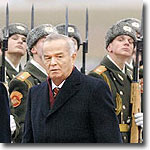
Commenting on the recent visits of prime ministers of Russia and Pakistan to Tashkent, some observers assumed that Uzbekistan was changing its pro-Russian foreign political course. The visits followed one another, and observers noticed the enthusiasm with which the local media covered the visit of Shavkat Aziz and the lack of interest in the visit of the Russian delegation under Mikhail Fradkov. An Uzbek Internet-resource even suggested that "Tashkent is shifting its foreign political bearings to cooperation with the brothers in faith."
Bearing in mind Uzbekistan's quite cold relations with a number of Moslem countries, that was an unexpected and hardly warranted conclusion. Where Pakistan is concerned, it was only recently that Tashkent accused it of proliferation of Islamic extremism and encouragement of violence in Uzbekistan. Foreign Minister of Uzbekistan Abdulaziz Kamilov announced in February 1997 that nearly 400 Uzbek citizens had been trained in special camps on the territory of Pakistan. Other similar accusations were made against Pakistan later on, when the Islamic Movement of Uzbekistan backed by the Taliban invaded the Ferghana Valley.
Relations between the two countries were practically non-existent until 2000 when Islamabad used its Taliban contacts to arrange a series of Uzbek-Afghani consultations beginning with a meeting between Kamilov and Mullah Mutavvakil of the Taliban.
As a matter of fact, this truly revolutionary step in the Uzbek foreign policy was born of necessity. Islamic Movement of Uzbekistan gunmen on the Afghani bank of the Amudarja were making threats to return to the Ferghana Valley. Military campaign in the Kyrgyz Batken in summer 1999 had demonstrated shortcomings of the regular Uzbek army - both in training and in equipment necessary for mountainous warfare. Made uneasy by the campaign, Tashkent signed a military-technical cooperation accord with Moscow in autumn 1999. It did not exactly help because the Russian military was not exactly in a hurry to provide hardware and weaponry.
Neither were peace overtures particularly helpful - international conferences with the warring Afghani parties participating. President Islam Karimov eventually made a statement that certainly made front pages in newspapers. "We may dislike the Taliban but that's a force we must take into account. We do not need a confrontation with Afghanistan," he said.
Where Tashkent is concerned, the Afghani civil strife and relations with Pakistan are inseparable from the problem of the Islamic Movement of Uzbekistan. Advancement of relations with these two countries made for a weakening of Islamic gunmen. Tashkent and Islamabad signed an accord on a joint war on terrorism and extradition treaty in 2001. With these two documents signed, Uzbekistan could be reasonably confident that gunmen of the Islamic Movement of Uzbekistan would enjoy no more clemency from the Pakistani authorities. The signing of the documents essentially restored bilateral relations.
The heads of states exchange official visits then. Aziz's visit is essentially a logical continuation of the dialogue launched 15 years ago. His predecessor Navaz Sharif announced in 1992 that the situation in Afghanistan was favorable and urged countries of the region (Iran, Turkey, Afghanistan, and Central Asian states) to establish an alliance to implement joint economic projects. Islamabad needed cotton then for its textile industry. Central Asian states and particularly Uzbekistan needed access to the Indian Ocean.
Aziz came to Tashkent not long ago with approximately the same list of issues for discussion. He said that his country's rapidly developing economy needed gas and electric power and offered Uzbekistan the use of the port of Pakistani port of Gvadar for exports of its goods to the world markets.
Clearly, all of that does not have anything to do with the vaunted "Islamic solidarity". Uzbekistan's foreign policy is quite pragmatic - just like foreign policies of its neighbors that need their own routes to the South. When the regional conference was taking place in Islamabad in May 2006, Tajikistan and Kyrgyzstan reiterated their willingness to export energy to Pakistan via Afghanistan. The project was code-named CASA-1000.
What effects will implementation of all these plans have on the relations with the northern neighbor? Is Uzbekistan really shifting its foreign political bearing points?
Establishment of transport routes to the southern seas (as well as oil, gas, and energy export from Central Asia) will only be possible with a whole number of problems solved first, and the situation in Afghanistan remains the central of them. Peace in this country remains a distant prospect, which means that the majority of these ambitious projects are doomed to remain on paper only.
Northward orientation on the other hand implies more than relations with Russian alone, the relations that may be revised - no problems with that. It also implies regional integration within the framework of the Organization of Eurasian Economic Cooperation, Shanghai Organization of Cooperation, and CIS Collective Security Treaty Organization where Russia is an instrumental player. A whole number of reasons makes alternatives to these projects non-existent for Central Asian states (with Turkmenistan being the only exception because is does not belong to these structures). On the other hand, it does not mean of course that a search for other partners is impossible.
It should be mentioned here that countries of the region are trying to promote multi-vector foreign policies. Consider Kazakhstan, a country appraised by the West as an "example of democratic development" and an ally of Russia at the same time. Also known as the locomotive force in the post-Soviet zone, Kazakhstan is an embodiment of all advantages of this policy. Diversification is the natural reaction to external challenges, confrontation between big-time players in the region being the central of them. Russia and the United States have been vying for dominance in the region since the middle of the 1990's. These days, they are joined by China and the European Union - the latter promoting construction of pipelines bypassing the territory of Russia.
It should be added as well that the suggested diversity of oil and gas transit routes promotes the interests of exporters - countries like Kazakhstan, Turkmenistan, and Uzbekistan that do not want to put all eggs in one basket (meaning to depend on the sole buyer). Playing on the discord between major powers, countries of the region expand their own room for maneuvering. The problem comes down to finding the balance that will benefit the ruling elites themselves and more or less satisfy the world players. That's an art countries of the region have to master yet.
Seeing others vie for clout with Central Asia, local elites inevitably become intractable. It is hardly surprising therefore that Fradkov's delegation encountered certain coldness and grudges in Tashkent. Three years ago, representatives of Gazprom and LUKoil came to Tashkent to sign cooperation accords and were met with fanfare and flowery rhetorics extolling them as strategic partners. Why bother with it now, when there are things to be done?
* * *
Sanobar Shermatova, member of the RIA-Novosti Expert Council, exclusive for Ferghana.Ru