


Reader’s letter: «No era may be forgotten»
Comments (0)
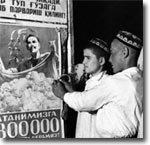
Picture: fragment of the photo by M. Penson "Collective farmers on the Tashkent region set out for the Chirchik construction site", 1939
* * *
I'm a Ferghana.Ru reader from Uzbekistan. Student of an institute, I teach contemporary history at a college at the same time. I'm not a journalist and therefore not particularly good at writing articles.
There are lots of interesting and unembellished articles on Uzbekistan on Ferghana.Ru web site. What I never seem to be able to find, however, is a piece on the new Uzbek authorities' attitude towards our recent past. It pains me to see what is happening in the country and how history from the time out of mind to these days is being revised.
The Uzbek authorities instructed historians to revise both the Soviet past (which would have been understandable) and ancient history. Dates of establishment of Uzbek cities beginning with major (Samarkand, Bukhara) and ending with small ones (like Karshi Margilan, Termez, and so on) were revised over the last several years.
In 2006, the republic solemnly celebrated the 2,700th anniversary of Karshi, a town which is now officially regarded as being just a little younger than Samarkand or Bukhara. Back in the Soviet Union, however, its age had been estimated at only 2,000 years.
All of the USSR celebrated the 2,500th jubilee of Samarkand in 1970. In 2006, the government of sovereign Uzbekistan ordered celebration of the 2,750th anniversary of Samarkand in 2007. Where did these previously unaccounted-for 250 years originate?
To make it all look better, the authorities arrange conferences, seminars, and exhibitions all over Uzbekistan where historians provide "evidence" which they believe necessitates this revision. Uzbek media outlets go out of their way to justify the authorities and the history revision campaign they have launched. Following their political masters, media outlets maintain in no uncertain terms that the Soviet power deliberately belittled the history of Uzbekistan. They never miss a chance to underestimate the instrumental role Russia has played in development of the science and culture of the Central Asian region. For some reason, they never admit that it is because of the Soviet power that the peoples of Central Asia (and, broader, all of the world) can admire our monuments of old.
Consider the discovery of the ancient site in the Selengur cave in the Ferghana region. Archaeologist U.Islamov discovered the site in 1985 and dated it as the early paleolithic age or 700-650 millennium B.C. The figure was revised in the late 1990's. Uzbek scientists now maintain that the site is 1.5 million years old. It is needed to corroborate the official hypothesis that views the territory of Uzbekistan as one of the centers of evolution of mankind.
This is but a single example of the policy promoted by the Uzbek authorities nowadays, a policy aimed to persuade the world that Uzbekistan is one of the centers of ancient civilizations on a part with Egyptian, Mesopotamian, Greek, etc. Along with everything else, this is a measure expected to imbue the feeling of "patriotism" in the young, the feeling of pride of their independent Motherland. Unfortunately, all these attempts patently backfire.
A great deal of questions arise in Uzbekistan that are never answered. Questions are particularly numerous in connection with how the authorities treat the recent Soviet past of Uzbekistan. This latter is regarded as absolutely and thoroughly negative.
No favorable mention of the Soviet past is permitted in Uzbekistan. This period of history is only to be regarded and referred to as the era of a "totalitarian regime". As a matter of fact, even the use of red color is discouraged - unofficially.
President Islam Karimov visited a Tashkent secondary school a couple of years ago and asked a student there if he knew the names of Khruchev, Brezhnev, or Andropov. Upon hearing a "no", Karimov beamed into TV cameras and announced that the youth was better off without any knowledge of the Soviet past.
No wonder young Uzbeks do not know the first thing of the recent past of the country. They do not know anything of men like Ahunbabayev, Yusupov, or Rashidov. As a matter of fact, these names and many others are not even mentioned in textbooks or historic literature. Needless to say, the same goes for the names of statesmen and party functionaries of the late USSR.
The district of Tashkent that once bore the name of Ikramov was renamed, last year. There are the persistent rumors that the streets and metro stations named after Hamza and other public figures will be renamed as well.
The authorities deny the young the knowledge and pride of the recent past. What can we expect from this generation then? Does it mean that the period we are living in now will also be forgotten several decades from now?
If it is, it will be our own fault!