


Kyrgyzstan after April 19. The authorities finish off the opposition
Comments (0)
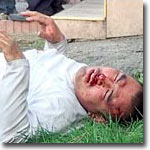
When protesters met the police with rocks on April 19, the protest rally in central Bishkek initially proclaimed as continuing was immediately dispersed. The Prosecutor General's Office opened a case (organization of mass disturbances). General public in the meantime took the developments in stride and actually approved of the decision to disperse the rally.
What did it all begin with? What is the new confrontation about?
Almost all Kurmanbek Bakiyev's former supporters joined the opposition right after March 2005 when he became the president. They announced that the constitution adopted by the former President Askar Akayev had to be corrected, presidential powers restricted.
Using protest rallies and actions, the opposition forced Bakiyev to adopt a new constitution last November, a document restricting his powers. When the opposition began celebrating its victory, however, Prime Minister Felix Kulov resigned and made formation of the new government impossible.
On December 30, the president had his supporters in the parliament adopt a new constitution that restored his previous powers. Bakiyev must have promised his partner in the former political tandem that he would become the prime minister again. As a matter of fact, Bakiyev himself said so when the parliament voted him down for the second time in a row.
Bakiyev's team executed a tactical move then and persuaded the president to nominate Kulov again. The parliament voted him down. Kulov's career in the upper echelons of state power was over.
Predictably enraged, the ex-premier joined the opposition and established the United Front this February. Leaders of other anti-Bakiyev forces joined it after some hesitation. Kulov then convinced everyone that mass protests should be launched on April 11 and that the state power would be passed down peacefully as a result.
Aware of the seriousness of the situation, the president made Almaz Atambayev the prime minister. He knew what he was doing because Atambayev's dislike of the new opposition leader was common knowledge. Atambayev had never trusted Kulov or missed a chance to point out that it was Kulov the premier who had all but annulled November accomplishments of the opposition.
Atambayev became the prime minister in early April. The political dividends the president earned were enormous. This move split the opposition. Moderate opposition leaders wouldn't support the demands of Bakiyev's resignation. Kulov and his supporters became known as radical opposition. Atambayev in the meantime formed a working group to amend the constitution but the radicals chose not to join it. The new constitution was drafted all the same. Somewhat restricting the presidential powers, it was expected to mollify the opposition but failed to do so.
Kulov and his team turned down the opportunity to save face through joining the working team and the coalition government.
The radical opposition displayed tenacity then. It expected the panic-stricken presidential team to advise Bakiyev to negotiate in the format the opposition insisted on. What it had failed to take into account was Bakiyev's own obstinacy.
April 11 came.
Nine days
The radical opposition launched an information war on the regime. It lasted between March 11 and April 11. The war was quite successful from the opposition's point of view but everything changed on April 11, the day the protest rally began. The 100,000 protesters the opposition had promised to muster failed to materialize. The nine days of the continuing rally were somewhat relaxed. It was clear even to the opposition itself that no peaceful passing down of the state power would take place. The opposition then set another date for the "peaceful revolution", April 19. It became the last day of the rally.
The decision to disperse it was logical. The authorities knew that the opposition itself wished it had never launched the rally.
When boozed up protesters began throwing rocks at the police cordons on April 19 and the interior minister himself turned up to address them, not one opposition leader could be found in the mob. The police used flash grenades and tear gas. The protesters did not particularly resist. Nine days of roughing it up in tents had been exacting. Moreover, very many protesters from the regions had gone home, mindful of the seed time.
On April 20, Bishkek woke up without the opposition in the central square.
United Front leaders called a press conference on April 19 night and announced that the clashes had been provoked by the police. Saying it, they knew that journalists did not believe them. These latter had seen everything with their own eyes, after all.
As a matter of fact, this turn of events was convenient for everyone. The radical opposition did not need the rally anymore. It was running out of money for the protesters and knew that people were heartily fed up with the rally. Things would have turned nasty with continuation of the rally. It was dispersed without any resistance. Most protesters were intellectuals, not used to violence. They were not at ease - and had not been for some days. Neither was Omurbek Tekebayev, the would be opposition candidate for president. The only man who could, in theory, win the presidential race, Tekebayev proved absolutely unprepared for violence.
Reaction of the authorities
On April 20, the authorities were waiting for the reaction of the population to the dispersal of the rally last night shown live and in color by all local TV networks. Residents of Bishkek did not really object to seeing no more protesters in the central square. Once it became convinced of its success, the regime proceeded to develop it.
Pro-presidential and centrist lawmakers made mincemeat of the parliamentary opposition that had been involved in organization of the rally. The parliament condemned organizers of the rally and passed a special resolution.
The Prosecutor General's Office opened a case and put the State Committee of National Security in charge of the investigation.
The investigation is under way now, with organizers of the rally being witnesses. The regime is thus offering the opposition another chance.
The temptation to finish the opposition off must be strong. Particularly since Kulov wouldn't give in.
Opposition leaders were already questioned - as a warning. Save for Kulov, all of them got the message.
Kulov himself, used as he is to crisis management, launched another game. Leaving the building of the State Committee of National Security where he had been questioned, Kulov said that "the north of the republic [most protesters had been from the north] feels abused and humiliated by Southerners..."
General Omurbek Suvanaliyev, another opposition leader, announced that the president had ordered police units from the south to disperse the rally of the Northerners. The thesis was clearly expected to excite the north of the republic but failed.
Kulov in the meantime is determined to play it out and persuade his following from the north that the Southerners had usurped everything. He seems unable to understand the failure of the rally or to admit it was a mistake.
The authorities in the meantime will apparently continue keeping organizers of the rally under pressure. Statements from "general public" condemning the opposition will follow soon.
Symptomatically, deputies of the opposition did not turn up to support Kulov. Immune to prosecution as they are, it was not the fear of being arrested that prevented them from doing so. Deputy Baibolov is convinced that "the authorities cannot imprison us." "They lack moral and material resources for that. It's a campaign of intimidation," he said. "As a matter of fact, there is more to it than meets the eye. The population is disgusted with what is happening in the country."
Atambayev thinks so too. "The people I was with in the opposition, organizers of the rally, are not in jail. They know how to extricate themselves," he told Radio Azatlyk (RL Kyrgyz Service). "It is kids who got jailed but who in the opposition cares? You saw with your own eyes how these kids assailed passing cars. What could we do? Give them a medal? Leaders of the opposition will duck responsibility, that much is clear. I know it for sure. Had the opposition demanded constitutional reforms, everything would have been different..."
"I wouldn't say it is political repressions under way," political scientist Orozbek Moldaliyev told Ferghana.Ru. "There is, however, a nuance to be pondered. The rally was dispersed on April 19 in the evening, and summons to the State Committee of National Security were delivered at 6 a.m. the following morning... It was wrong, by the way, to close down opposition newspapers without a court warrant."
The regime, encouraged by its success, will probably put the reforms on hold, and that is probably the worst corollary of what has happened. Clumsiness of the opposition discredited the very idea of constitutional reforms. Count on the authorities to fake the reforms.