


Freedom of Press Day in Uzbekistan: celebrating what does not exist
Comments (0)
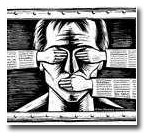
Ironically as it is but winners of the Golden Pen National Award (Oltin Kalam) in Uzbekistan were honored at a posh ceremony in Tashkent on May 3, Freedom of Press Day and the day free-lance journalist Umida Niyazova was sentenced to seven years behind the bars.
"The role media outlets are playing in development of the processes of democratization and renovation, modernization and reorganization of the country under President Islam Karimov was eulogized at the event dedicated to May 3 or the International Freedom of Press Day," Uzbek media outlets reported. "Sovereignty and independence made media outlets true promoters of the productive reforms under way in the country." That's what media outlets truly are nowadays. The authorities of Uzbekistan have tamed the colossal army of journalists and made the latter supporters of the state ideology rapidly becoming uglier and uglier.
Even results of the Golden Pen contest confirm this assumption. (It should be noted here that Uzbek media outlets are somewhat at a loss as to the nature of the contest and call it sometimes national and sometimes international.) More than 30 winners were awarded on May 3, all of them appraised by the Uzbek TV as "gifted and active domestic and foreign journalists known for their unbiased and truthful stand on the state of affairs in Uzbekistan", and not one of them could boast of a single truly unprejudiced article. How come? Simple. Journalists with the courage to make unprejudiced reports left the country long ago. Whoever chose to remain in Uzbekistan counting on the authorities' discretion is either in jail or about to be imprisoned.
Deputy Premier Aripov attended the ceremony where the nominees were awarded for "socially active programs; cycle of programs on the role of women in society; analysis of problems of rural areas; programs promoting national values" and even "materials on Internet journalism". Sports commentators, Uzbektelefilm studios directors, and representatives of Uzbeknavo entertainment association were awarded. What the latter have to do with freedom of expression is anyone's guess. The head of the Tashkent office of the Turkish radio and TV was one of the nominees (probably to emphasize the international nature of the event). Representatives of NNM, UNESCO, and World Bank were present as well, adding to pomposity of the occasion.
The Golden Pen Award was founded on the initiative of the Uzbek Union of Journalists and International Public Center for Retraining of Journalists two years ago, right in the wake of the tragedy in Andijan that lunched an unprecedented campaign of terror against freedom of expression in Uzbekistan. It is hardly surprising really. It is even logical in the country where every phenomenon and notion inevitably takes an abhorrent shape, where true believers are imprisoned as extremists and terrorists, and where V-Day becomes the Memory Day even though WWII veterans are practically forgotten about.
"Some analysts point out that the so called color revolutions are accompanied by strong information pressure from the West," a tame journalist wrote in his piece. "Uzbekistan found itself under a major information attack during and after the events in Andijan. With the country under information attack, Uzbek journalists found themselves facing a task of paramount importance. Fortunately, they proved capable of repelling any information offensive." It stands to reason to assume that the journalists who had repelled this attack were awarded on May 3.
Practically all materials in the media begin with a prelude where the authors mention some presidential decree or the phrase of the president who "takes care of everything, always." Even what twins are born in Uzbekistan do so only due to the care the president is taking of his subjects. Some infrequent materials criticizing petty officials do appear in the media but even they do not fool anyone. It is clear that these materials are permitted by the authorities as a means of creating the illusion of democracy.
The Golden Pen Award ceremony took place in Uzbekistan when the international community was condemning Tashkent for the trials of Umida Niyazova and Gulbahor Turayeva sentenced to six and six years imprisonment for doing their jobs. Badgered by international human rights organizations and other structures and speaking on behalf of the European Union, Germany released an official statement demanding a revision of the sentences and threatening Uzbekistan with extension of sanctions.
Unfortunately, Turayeva and Niyazova are not the last victims of the latest campaign against free-lance journalists and human rights activists gaining momentum in Uzbekistan. Natalia Bushuyeva and Yuri Chernogayev of Deutsche Welle may find themselves in jails too under the faked charges of operating without a license and tax-evasion.
Whatever journalist in Uzbekistan works with or for foreign media outlets is running a grave risk nowadays. This is how the Uzbek authorities promote freedom of expression in the country. Galima Buharbayeva, the Uzbek journalist who fled Uzbekistan in the wake of the tragedy in Andijan and ended up in the United States, wrote in her virtual address to Niyazova that the authorities are making in mistake because "repressions or not, a handful of the truly courageous will always turn up to put up a fight for the ideals of humanism and freedom."
The International Freedom of Press Day is the day of these courageous persons, even without posh awards and antes.