


Latin alphabet in Uzbekistan: difficulties of transition
Comments (0)
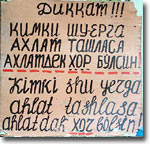
Ferghana.Ru continues its series of publications on transition to the Latin alphabet in Uzbekistan. Why would the authorities order it? What are the pros and cons of the new alphabet? Who is the Latin alphabet being incorporated into everyday life? Answers to these and other questions are given by Uzbek scientists, political scientists, public characters, and journalists.
Journalist Alisher Taksanov: - It was a political question rather then technical. Nationalists became loud in Uzbekistan in the late 1980's and began talking of how it was necessary to cleanse the Uzbek language of Russian words and everything even remotely connected with Moscow. Politically, Uzbekistan was ready. Its Slavic "brothers" had ruined the Soviet Union, established the Commonwealth, threw us out of the ruble zone, reduced trade flows to a mere trickle... Politicians in Moscow were arrogantly talking of Russia's "underbelly". Turkey began gaining clout with Central Asia then and no wonder since we shared a common language, faith, mentality, and history.
Uzbekistan disassociated itself from the "elder brother" in 1993. Transition to the Latin alphabet was suggested within the framework of discourse of the necessity to forget the past and begin from scratch. This transition is therefore the price Uzbekistan was expected to pay for integration with Turkey and West Europe. Few if anybody at all gave a thought to the financial side of the matter. Or, for that matter, to the conflict of generations taught to read Uzbek differently.
It will be wrong to say that the transition to the Latin alphabet is a success because 90% of all periodicals are published in Cyrillic. When this generation of adults passed away, then the Latin alphabet will become fully accepted indeed. The Uzbek population is evenly split between the Latin and Cyrillic alphabets now. This ratio will be gradually changing in favor of the former if the reform is driven to its logical conclusion.
Political scientist Farhod Tolipov: - Transition to the Latin alphabet was associated with independence and sovereignty. Like other Central Asian republics and other post-Soviet states, newly sovereign Uzbekistan began reanimation of its pre-Soviet past and history. It was an attempt to restore the status quo that had existed before the Soviet Union. Since we had been using the Latin alphabet once, it must have become the decisive factor for the transition. And the decision was made in the 1990's. I'd say that the transition to the Latin alphabet became a symbol of independence and restoration of pre-Soviet realities.
Professor Goga Hidojatov, Honored Worker of Science, historian: - It did not even begin in the early 1990's. It had begun in the late 1980's, in 1989, when scientists under Kuchkartayev, a prominent Turkic researcher, decided on a shift to the Latin alphabet. They were more than nationalists, you know. They were ultranationalists. These men under Muhammad Salih and Abdurahim Pulatov were after popularity, nothing more. They did not care about the vast literature and cultural legacy accumulated in the half a century of the use of the Cyrillic alphabet...
I objected then. I was a dedicated opponent to the idea then and remain one now. In the meantime, relations with Turkey began rapidly improving in the early 1990's and it was known that Turkey itself had made the transition to the Latin alphabet in 1928. It kowtowed to the West, to West Europe, and wanted to be like West Europe even at the cost of its national ways and traditions. What did this transition earn Turkey? Only 60% of the population of Turkey are literate nowadays. This is a semi-literate country because the Latin alphabet does not fit Turkic languages. Ahundov, a prominent Azerbaijani enlightener and writer, wrote in the 19th century that adapted Cyrillic was the best possible alphabet for the Turkic peoples. Ahundov was the first to promote the necessity of abandoning the Arab graphics that he thought had spoiled the Turkic peoples in favor of Cyrillic. I'm still convinced that Uzbekistan made a wrong decision when it abandoned Cyrillic for Latin.
My opponents say that the reversal I suggest will necessitate doing something about youngsters, a whole generation of them, taught Latin at schools. So what? Practically all newspapers in Uzbekistan are still published in the Cyrillic alphabet. I'm convinced therefore that we should know better than emulate Turkey. Turks are not an example for us to follow. We are an enlightened country where the literacy level is practically 100% - thanks to the Cyrillic alphabet, by the way.
Speaking at an international conference in Istanbul, I said Turkey could not be an example for Uzbekistan because it itself had only 60% of literate population. The audience was enraged. They started screaming that it was a lie, that I had been misinformed. "Read your own newspapers, will you?" I told them then...
I believe therefore that we had better forget Turkish examples, models, whatever. We have our own way of development and we should follow it.
As for alphabets, I remain a dedicated advocate of the Cyrillic alphabet and I think that 90% of our intelligentsia think likewise. I do not think that we should listen to nationalists like Salih and Pulatov. There were nationalists in the 1920's and 1930's too, but they did offer some positive ways of development. Consider the jadids - enlighteners like the ones in France - who stood for liberal democratic reforms and for progress.
Poet and journalist Rahimjon Rahmat: - Abandonment of an alphabet in favor of another always has a thoroughly negative effect on society. Transition to the Latin alphabet has been a pain - with nothing to show for it. The reform may have the desired effect 20 or 30 years from now, but assessing it at this point is a sheer impossibility.
Uzbekistan as a Soviet republic had nearly 1,500 book stores. It has only 18 now. I know what I'm talking about. I was given these figures by a friend who is in books himself. There are no book stores in district centers or bazaars - only newspaper stalls. There were lots of book stores in Tashkent itself but they all went broke. Just fancy: 26 million people in the country and 18 book stores!