


Election in Kyrgyzstan bears a strong resemblance to the recent parliamentary campaign in Russia
Comments (0)
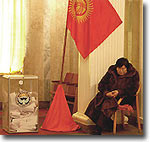
Who would have thought that in less than three years after the Tulip Revolution in Kyrgyzstan the parliamentary election in this country would resemble the recent Russian campaign or that this small republic located between China, Kazakhstan, and Uzbekistan would become a Central Asian Putistan with its political system and rules of the game? Establishment of the new parliament where the tune will be called by pro-president Ak Jol [Light Way] with its wild promises to voters, clean-up operations in the political terrain against the weak and weaned opposition, protestations from the latter that cannot change anything - all of that and many other nuances inevitably remind observers of the parliamentary campaign in Russia that culminated on December 2.
As a matter of fact, the resemblance mostly comes down to a common idea that enabled ruling parties in both countries to remain out of their political rivals' reach. In both cases, the ruling parties capitalized on the idea of stability they themselves promised to become guarantors of - stability as a means of defense from political adventure-seekers, demagogues, retrogrades, and other public enemies. Promises to put an end to the period of political tumult and economic mayhem never fail to have the desired effect on society heartily fed up with disturbances.
In a word, Tulip Revolution in Kyrgyzstan has lost the momentum and is therefore giving way to restoration. Will the country succeed in conversion of the political stability promised it by Ak Jol into a genuine economic development and social prosperity? Logic of an ordinary voter who has privately decided not to give a damn about politics anymore is understandable. It does not mean, however, that the Kyrgyz ruling party can deliver. Kyrgyzstan is not a much larger Kazakhstan or a vastly larger Russia with their oil and gas fields and other natural riches that enable their authorities to keep up socioeconomic parameters at the desired levels - and therefore to keep capitalizing on the idea of stability. Granted that Kyrgyzstan has some oil and even gold, only the innocent will expect that their existence will have any noticeable effect on the economy. Trust and faith in Ak Jol may evaporate fast. What then?
It may be added here that the idea that the authorities must mould politics to their liking if they want progress for their country (the idea that has taken root in Russia and been transferred to Kyrgyzstan now) belongs to Den Siao Ping of China. A member of the Shanghai Cooperation Organization together with Russia, Kazakhstan, and China, Kyrgyzstan can but look up at these colossi with envy. Trying to emulate them, it will but repeat its mistakes.
Observer Sergei Strokan, Kommersant, December 17, 2007, p. 9. © Translated by Ferghana.Ru