


Danish journalist Michael Andersen: I am ashamed that European media and politicians do not understand the tragedy in Kyrgyzstan
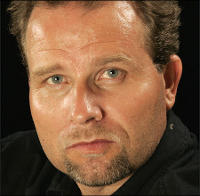
- Michael, what is the reaction of Europe and European media to the events in Kyrgyzstan?
- Unfortunately, the response is very weak. However cynical it sounds, it is summer and time for the World Cup. There are many other stories, more ‘important’ than what is happening in Osh. This is very sad and tragic: unfortunately, it is the truth. The main reason is there are no "pictures", good photos or videos – since Osh, as you know, is blocked. Without good visuals, there is very little interest. Not many Western correspondents are based in Kyrgyzstan – therefore, western media do not have their own reliable information. They copy messages from Ferghana.Ru and other agencies.
- When Russia sent tanks to South Ossetia and Abkhazia there were no western correspondents there either but they arrived shortly…
- It is sad to admit but - compared with Georgia where there were ‘strong’ videos for television, and there was "our enemy" Putin and "our friend" Saakashvili… whereas Europeans simply do not understand what is going on in Osh right now. Who are these "Kyrgyz" and "Uzbeks"? 99 percent of western people are not even aware of the existence of these ethnic groups or Osh. There are no good shots, nobody knows who these Kyrgyz and Uzbeks are…Even if a western politician announces his position on the events in Osh, he will gain anything politically.
I know that European Union said it will send negotiations experts or a fact finding mission to Kyrgyzstan. I would not even pay attention to this; it sounded like a bad joke. This is just disrespectful.
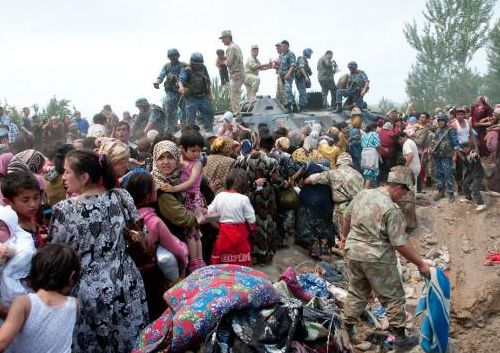
The pictures from Kyrgyzstan become more accessible. People cross the Uzbek border. June 12-13, 2010 Photo © Eurasianet
- It is clear that tragedy in Osh is not the subject of headlines in European newspapers. If they still mention these events in what form they do it?
- Unfortunately, Western media fall back on stereotypes, describing events in Osh such as "interethnic violence" and "interethnic problems", although you and I know that that is not really what is happening. Often when I suggest writing about such topic, the first question they ask is "Michael, what is the Danish interest, the Danish angle?" If I write for British media, they would ask about British interests. If there is none, they prefer stories about Brad Pitt, Angelina Jolie and Madonna. Because that is what sells newspapers.
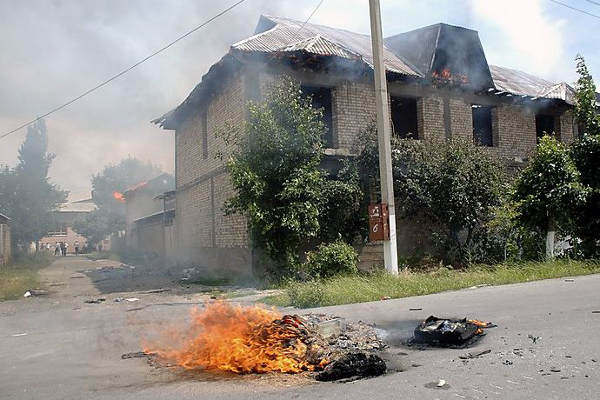
Burned houses in Osh. Photo © Eurasianet
- Obviously, there is no European interest in Osh. Is it true that even the question of NATO transit to Afghanistan cannot generate interest?
- Only for Americans. Europeans showed no real interest even after the April revolution. Bakiev was in power – ok. Roza takes over – ok. The revolution was in the headlines for a couple of days because there were ‘good’ images. But that does not mean that people are aware of what really happened or understood the background.
The Americans immediately sent an envoy to Bishkek. Not to talk about democracy, but to ensure continued access from to the Manas base from the interim government.
I am ashamed that western media pay so little attention and produce such poor coverage. This is bad. Another bad thing is the constant use of stereotypes - often wrong.
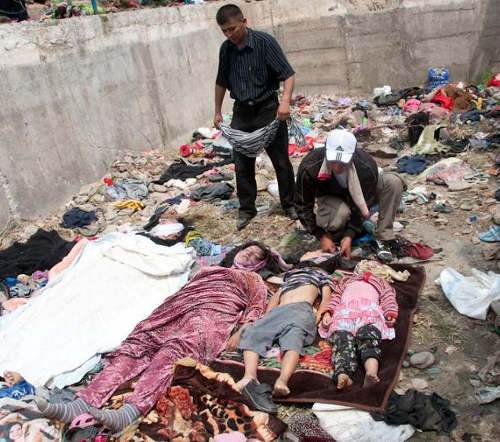
The victims of ethnic cleansing: this Uzbek woman and her children were shot down in Kyrgyzstan while trying to escape to neighboring Uzbekistan. Photo © Eurasianet
- Perhaps, western media do not want to raise this issue in order to avoid the analogies with Kosovo and ethnic cleansing in Europe?
- Yes, this is interesting parallel. I worked in Bosnia in that period. In the first 2-3 years of the war, the West just observed. People were killing each other, but on an officiallevel, Western Europe, did absolutely nothing… Events in Kyrgyzstan present little interest to the media in Germany, Great Britain, Spain and Eastern Europe… If and when we will start seeing videos of the atrocities, there might be more of a response.
- Kyrgyzstan is far from European readers and mass media pay no interest either. What about the expert community? Is there anyone monitoring the events in South Kyrgyzstan, you know?
- Certainly, there is interest amongst experts. There are groups of sociologists and political scientists. There is Scandinavian council for Central Asia – we meet on a regular basis… They publish reports dedicated to this topic, but this is an isolated community. Experts are interesting people but often they do not manage to get their view point across very efficiently.
Maria Yanovskaya