


Elections 2015: Fear and indifference in Tashkent
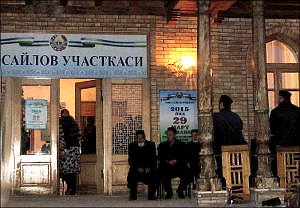
“Everyone is voting for Karimov, our entire family,” says a clean-cut and round-faced storeowner in Tashkent’s Labzak district. “Another person will be thinking about himself for the next 20 years. But he [Karimov] does not think about himself, thinks about his people only.”
The storeowner rearranges things on the counter and hides his cell phone in the pocket – just in case.
“In our neighbourhood, in each household there are two cars—there is no more room in backyards, so they leave their cars on the street. And nobody will hijack those cars. Because they are afraid.”
A visit to polling stations in Tashkent instantly refutes stereotype about Uzbeks’s indifference to politics. Voters flock incessantly to polling stations despite a chilling wind and an unexpected snowfall in Tashkent.
People are voting, and not just the ever-active pensioners: the young, the middle-aged, entire families, some with small children. They register at the desks with lists of names, show their passports, receive ballots and walk into curtained booths to put the plus sign—or a cross— next to the name of one of the four presidential hopefuls.
However, a very cautious survey —cautious, of course, lest the interviewer wants to be turned over to the ubiquitous plainclothes and police in green uniforms who throng the city today— unveils a totally different attitude.
For instance, few are aware that today is the election day. Some were surprised to hear Karimov needs an election at all. Most refuse to speak or frighteningly start assuring that there could be no better candidate.
But their darting eyes prove they are lying.
The key word in today’s elections is fear. Fear of the known and a greater fear of the unknown. The state instils fear in everyone; fear has become part of the common psyche, turned into a collective Stockholm syndrome. Those who do have the courage to say something echo each other.
“Another [president] will eat us alive,” pontificates a woman walking from the Chorsu Bazaar with bags full of groceries. “This one [Karimov] has already eaten enough. We know what to expect from him. We have learnt how to live under him.”
Several others repeat the-lesser-of-the-two evils philosophy and cannibalistic metaphors. Yet, at the same time, they enjoy talking about how friends and relatives succeeded in Moscow, Almaty, Seoul or New York. One cannot chose one’s Motherland. Let alone its head.
Fear of the unknown is worse. Stronger. Gloomier. And it’s not about a distant theoretical possibility that the caricature-like hopeful named Ketmonov could seize the power. It’s about today’s world where the new is not necessarily the better.
Muhammad Salih, the main opponent of Islam Karimov to date since the elections in 1991.